Quality ISO:9001 Certificate


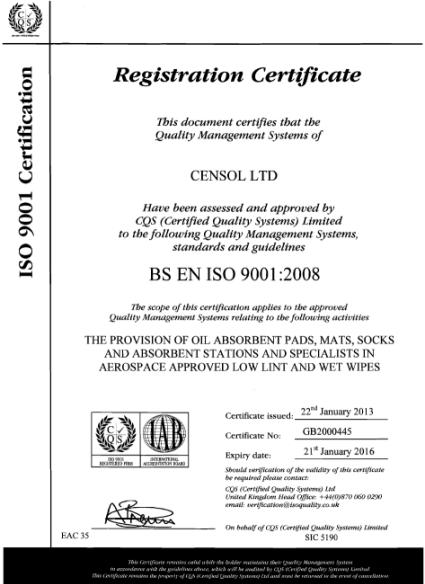
Censol are fully ISO:9001 certified. Because of this you can expect the highest quality service, prices and customer care when dealing with Censol.

We have been successfully assessed to the new BS EN ISO 9001 standard. This standard focuses very much on customer satisfaction which includes the setting of Customer Satisfaction Objectives.

These objectives apply to all staff and are intended to compliment our organisations activity which is to provide a first class service to our customers.
• Our customers will be treated professionally, efficiently and with courtesy at all times.
• Our telephones will be answered within 3 rings during working hours
• All enquiries will be responded to the same day they are received.
• We will supply quality products at competitive prices
• All orders will be inspected twice before despatch to cut down on human error
• We guarantee to give 100% effort towards personal service and customer satisfaction


ISO Definitions...

So what are the main points of ISO?

Conformity
Conformity is all about meeting requirements. ISO 9001 2000 lists many quality system requirements. If your organization meets these requirements, you can say that it conforms to these requirements.

Continual improvement
Continual improvement is a set of activities that an organization routinely carries out in order to enhance its ability to meet requirements. Continual improvement can be achieved by carrying out internal audits, performing management reviews, analyzing data, and implementing corrective and preventive actions.

Contract review
Contract review is a set of activities that an organization carries out in order to make sure that customer orders and contracts specify all the requirements that must be met, and in order to establish that the organization can actually meet these requirements.

Corrective actions
Corrective actions are steps that are taken to remove the causes of an existing nonconformity or to make quality improvements. Corrective actions address actual problems. In general, the corrective action process can be thought of as a problem solving process.

Customers
A customer is anyone who receives products or services from a supplier. A customer can be either external or internal to the supplier organization.

Customer satisfaction
Customer satisfaction is a perception. It is also a question of degree. It can vary from high satisfaction to low satisfaction. If customers believe that you've met their requirements, they experience high satisfaction. If they believe that you've not met their requirements, they experience low satisfaction.

Design review
A design review is a set of activities whose purpose is to evaluate how well a potential product (a design) meets all quality requirements. During the course of this review, problems must be identified and solutions must be developed.

Design validation
Design validation is a process whose purpose is to examine products and to use objective evidence to confirm that these products meet user needs.

Design verification
Design verification is a process whose purpose is to examine design outputs and to use objective evidence to confirm that outputs meet input requirements.

Entity
An entity could be a product, process, person, activity, machine, service, system, department, company, institution, or organization.

Infrastructure
The term infrastructure includes buildings, workspaces, equipment, hardware, software, utilities, and support services such as transportation and communication.

Internal quality audit
Internal audits are carried out by your personnel. Internal quality audits examine the elements of a quality management system in order to evaluate how well these elements comply with quality system requirements.

Management review
The purpose of a management review is to evaluate the overall performance of an organization's quality management system and to identify improvement opportunities. These reviews are carried out by the organization's top managers and are done on a regular basis.

Nonconforming products
When one or more characteristics of a product fail to meet specified requirements, it is referred to as a nonconforming product. When a product deviates from quality requirements, it fails to conform.

Nonconformity
ISO 9001 2000 lists quality management system requirements. When your organization deviates from these requirements, a nonconformity occurs. When a product, process, procedure, system, or structure deviates from ISO requirements, a formal nonconformity exists.

Organization
An organization is a company, corporation, firm, or institution that has its own functions and administration. It can be either incorporated or unincorporated, privately or publicly owned.

Organizational structure
The structure of an organization is the pattern of responsibilities, authorities, and relationships that control how people perform their functions and govern how they interact with one another.

Preventive actions
Preventive actions are steps that are taken to remove the causes of potential nonconformities or to make quality improvements. Preventive actions address potential problems, ones that haven't yet occurred. In general, the preventive action process can be thought of as a risk analysis process.

Procedures
Quality procedures control processes or activities. A well defined procedure controls a logically distinct process or activity, including the associated inputs and outputs. Such a procedure defines the work that should be done, and explains how it should be done, who should do it, and under what circumstances. In addition, it explains what authority and what responsibility has been allocated, which supplies and materials should be used, and which documents and records must be used to carry out the work. While quality procedures may be documented or undocumented, ISO usually expects them to be documented.

Process
In general, a process uses resources to transform inputs into outputs. In every case, inputs are turned into outputs because some kind of work, activity, or function is carried out. Processes can be administrative, industrial, agricultural, governmental, chemical, mechanical, electrical, and so on. An ISO 9001 Quality Management System is made up of the following processes:

• Purchasing process.
• Production process.
• Product design process.
• Product protection process.
• Service provision process.
• Document control process.
• Record keeping process.
• Internal audit process.
• Planning process.
• Training process.
• Monitoring process.
• Measurement process.
• Market research process.
• Regulatory research process.
• Continual improvement process.
• Internal Communications process.
• Customer Communications process.
• Customer needs assessment process.
• Nonconformance management process.


Process approach
The process approach is a management strategy. When managers use a process approach, it means that they control the processes that make up a Quality Management System, the interaction between these processes, and the inputs and outputs that glue these processes together. It means that they manage by focusing on processes. Product A product is an output that results from a process. Products can be tangible or intangible, a thing or an idea, hardware or software, information or knowledge, a process or procedure, a service or function, or a concept or creation. Please note that when ISO uses the term product they also mean service.

Product inspection
Product inspection is an activity that compares product characteristics with product requirements in order to establish conformity. More precisely, product inspection is an activity that compares one or more characteristics of a product with specified requirements in order to determine if the product meets these requirements.

Product nonconformity
When one or more characteristics of a product fail to meet specified requirements, they are referred to as product nonconformities.

Product realization
A product starts out as an idea. The idea is realized or actualized by following a set of product realization processes. So product realization refers to all the processes that are used to bring products into being.

Quality
A quality is a characteristic that a product or service must have. For example, products must be reliable, useable, and repairable. These are some of the characteristics that a good quality product must have. Similarly, service should be courteous, efficient, and effective. These are some of the characteristics that a good quality service must have. In short, a quality is a desirable characteristic. However, not all qualities are equal. Some are more important than others. The most important qualities are the ones that customers want. These are the qualities that products and services must have. So providing quality products and services is all about meeting customer requirements. It's all about meeting the needs and expectations of customers. So a quality product or service is one that meets the needs and expecations of customers.

Quality assurance
Quality assurance (Q.A.) is defined as a set of activities whose purpose is to demonstrate that an entity meets all quality requirements. Q.A. activities are carried out in order to inspire the confidence of both customers and managers, confidence that all quality requirements are being met.

Quality audits
Quality audits examine the elements of a quality management system in order to evaluate how well these elements comply with quality system requirements.

Quality control
Quality control is defined as a set of activities or techniques whose purpose is to ensure that all quality requirements are being met. In order to achieve this purpose, processes are monitored and performance problems are solved.

Quality improvement
Quality improvement refers to anything that enhances an organization's ability to meet quality requirements.

Quality management
Quality management includes all the activities that managers carry out in an effort to implement their quality policy. These activities include quality planning, quality control, quality assurance, and quality improvement.

Quality manual
A quality manual documents an organization's Quality Management System. It can be a paper manual or an electronic manual.

Quality planning
Quality planning is defined as a set of activities whose purpose is to define quality system policies, objectives, and requirements, and to explain how these policies will be applied, how these objectives will be achieved, and how these requirements will be met. It is always future oriented.

Quality plan
A quality plan explains how you intend to apply your quality policies, achieve your quality objectives, and meet your quality system requirements.

Quality policy
A quality policy statement defines or describes an organization's commitment to quality.

Quality record
A quality record contains objective evidence which shows how well a quality requirement is being met or how well a quality process is performing. It always documents what has happened in the past.

Quality requirement
A quality requirement is a characteristic that an entity must have. For example, a customer may require that a particular product (entity) achieve a specific dependability score (characteristic).

Quality surveillance
Quality surveillance is a set of activities whose purpose is to monitor an entity and review its records to prove that quality requirements are being met.

Quality management system
A quality management system is a web of interconnected processes. Each process uses resources to turn inputs into outputs. And all of these processes are interconnected by means of many input-output relationships. Every process generates at least one output, and this output becomes an input for another process. These input-output relationships glue all of these processes together - that's what makes it a system.

Quality system requirement
A quality is a characteristic. A system is a set of interrelated processes, and a requirement is an obligation. Therefore, a quality system requirement is a characteristic that a process must have.

Record
A record is a document that contains objective evidence which shows how well activities are being performed or what kind of results are being achieved. It always documents what has happened in the past.

Requirement
A requirement is a need, expectation, or obligation. It can be stated or implied by an organization, its customers, or other interested parties. There are many types of requirements. Some of these include quality requirements, customer requirements, management requirements, and product requirements.

Resources
Resources include people, money, information, knowledge, skill, energy, facilities, machines, tools, equipment, technologies, and techniques.

Service
Service is a customer-oriented result. This result is produced when an organization performs activities that are oriented towards meeting customer needs and expectations.

Service delivery
Service delivery is a customer-oriented activity. Service delivery activities are carried out by organizations and are oriented towards meeting customer needs and expectations.

Special process
A special process is any production or service delivery process that generates outputs that cannot be measured, monitored, or verified until it's too late. It's often too late because deficiencies may not be obvious until after the resulting products have been used or services have been delivered. In order to prevent output deficiencies, these special processes must be validated in order to prove that they can generate planned results.

Standard
A standard is a document. It is a set of rules that control how people develop and manage materials, products, services, technologies, processes, and systems. ISO's standards are agreements. ISO refers to them as agreements because its members must agree on content and give formal approval before they are published. ISO standards are developed by technical committees. Members of these technical committees come from many countries. Therefore, ISO standards tend to have very broad support.

Supplier
A supplier is an organization that provides products or services to customers. Customers can be either internal or external to the supplier organization.

Total quality management
Total quality management is defined as a management approach that tries to achieve and sustain long-term organizational success by encouraging employee feedback and participation, satisfying customer needs and expectations, respecting societal values and beliefs, and obeying governmental statutes and regulations.

Work environment
The term work environment refers to all the factors that influence work. In general, these include social, cultural, psychological, physical, and environmental conditions. The term work environment includes lighting, temperature, and noise factors, as well as the whole range of ergonomic influences. It also includes things like supervisory practices as well as reward and recognition programs. All of these things influence how work is performed.
